Denver Personal Injury Attorney Guide: Early Steps, Time Limits and Choosing a Lawyer
Last updated
People injured in Denver usually face the same early questions: what to document, which reports to request, how long a claim stays open, and how to find a personal injury attorney they can trust. The Census Bureau puts the 2025 population of Denver near 740,613.
The points below rely on Colorado statutes and official agency websites, reviewed November 2026. Busy routes in the city include Colorado Boulevard, Colfax Avenue, I-70 and I-25.
Early Steps After Getting Hurt in Denver
A clear record made early is hard to argue with later.
- See a medical provider quickly and keep the follow-up appointments, so the injury is documented from the start.
- When a vehicle is involved, every driver must stop, assist the injured and report the collision, as C.R.S. 42-4-1601, 42-4-1603 and 42-4-1606 require.
- When the injury happened on a business or home property, give the owner written notice and ask them to keep any video and incident reports.
- Take pictures of the location, the condition that caused the harm and your injuries, and get contact details from witnesses.
- Store medical bills, records of lost wages and a simple symptom diary together.
Requesting Reports in Denver
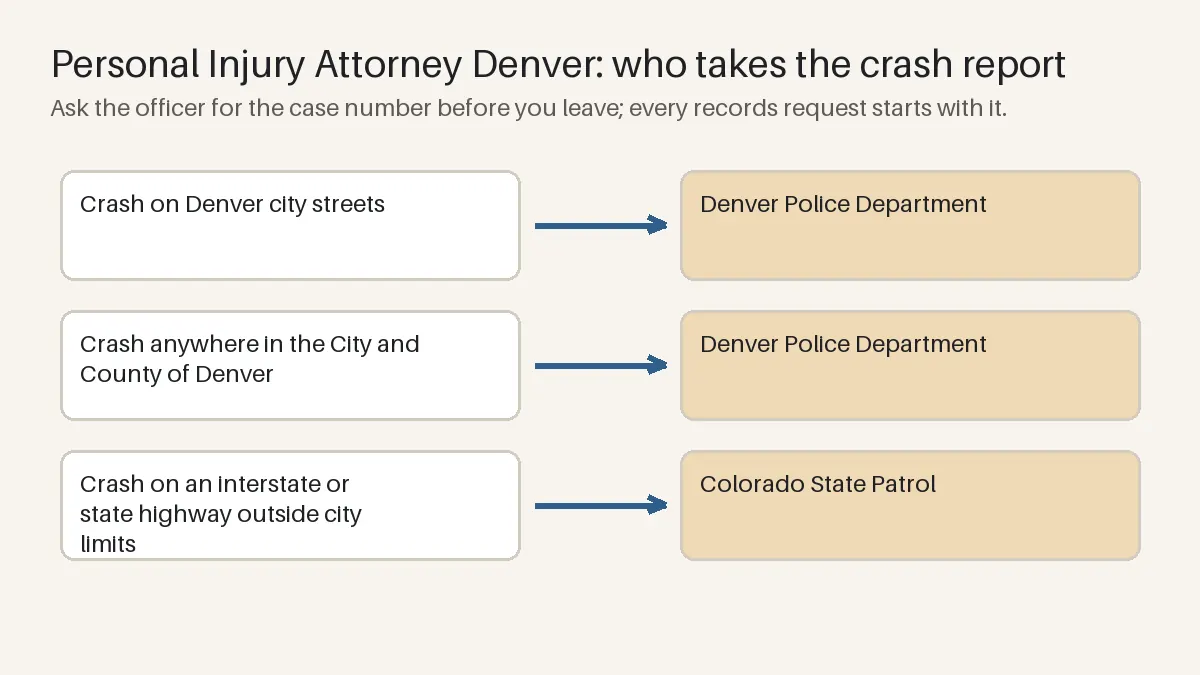
The responding agency keeps the report, so have the case number ready when you ask.
- Inside city limits: reports are written by the Denver Police Department, and its records page explains how to ask for one.
- Outside city limits in Denver: none exist, because the city and the county are one government, and the Denver Police Department answers calls countywide.
- On interstates and state highways in unincorporated areas the Colorado State Patrol usually takes the report; its crash information page lists how to request it.
Time Limits and Key Colorado Injury Laws
- General rule: two years to sue for personal injury, C.R.S. 13-80-102(1)(a). Motor vehicle injuries: three years, C.R.S. 13-80-101(1)(n).
- Public entities: a written notice of claim is due within 182 days after the injury is discovered, C.R.S. 24-10-109.
- Comparative fault: an award shrinks by the injured person's percentage of fault and is barred at 50 percent or higher, C.R.S. 13-21-111.
- Property owners' duties are set by the Premises Liability Act, C.R.S. 13-21-115; dog owners' liability for serious bites, by C.R.S. 13-21-124.
- Car insurance minimums often matter when an injury comes from a crash: Colorado policies must carry at least $25,000 per person, $50,000 per accident and $15,000 for property damage, under C.R.S. 10-4-620.
The Court for Denver Injury Claims
Civil injury suits arising in Denver usually go to the Denver District Court (2nd Judicial District), located at 1437 Bannock Street, Denver, CO 80202 (Denver City & County Building, civil matters). Claims of lower value may go to county court, and settlement is far more common than trial.
Injury and Crash Figures for the Area
Federal crash records count 63 traffic deaths in Denver County during 2024 (FARS data), a total that spans every road in the county, not only city streets.
Choosing a Personal Injury Attorney in Denver
- Look the attorney up in the Office of Attorney Regulation Counsel's attorney search to confirm active status and any public discipline.
- Ask about experience with your type of injury claim, including cases that went to trial.
- Require a signed, written contingency agreement, which Colorado Rule of Professional Conduct 1.5(c) mandates, and ask how costs are repaid.
- Treat unsolicited outreach soon after an injury as a warning sign: C.R.S. 13-93-111 prohibits soliciting injured people within 30 days.